


ChatGPT Ads : Should You Consider Them?
Ads on ChatGPT are the big news of 2026. The digital advertising ecosystem is undergoing an unprecedented transformation. While traditional pay-per-click (PPC) advertising has long been based on specific keywords on search engines, the emergence of generative artificial intelligence is opening up new possibilities. Among the features most closely scrutinized by marketers, the arrival of ads on ChatGPT is generating significant interest.
For companies seeking to diversify their customer acquisition channels, working with their agency on innovative strategies is a priority. But does that mean they should dive headfirst into ChatGPT advertising today—especially while also optimizing modern platforms, such as AI integration with WordPress?
Here is a comprehensive analysis of the challenges, how it works, and the real opportunities offered by this new channel.
A New Channel Amid Changing Search Habits
First and foremost, the way people consume information has changed radically. For a segment of users, ChatGPT has already partially or completely replaced Google for everyday searches. In June 2026, the National Bank of Canada reported that 39% of Canadians use AI to guide their purchases.
For companies already leveraging advanced technologies, advertising on ChatGPT appears to be the logical next step in their digital presence. Being present right where decisions are made offers prime visibility to a captive and engaged audience.
Is this really the case?
How does advertising on ChatGPT work?
ChatGPT Ads launched in Canada a few months ago. We’ve observed how it works and reviewed the documentation to provide you with a summary of its functionality.
Ad Display and Format
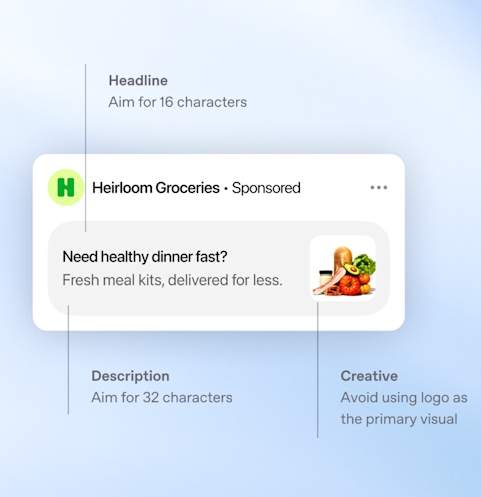
The most common format currently is a carousel of product cards featuring a title, a short description, and a small image. This is a useful solution for e-commerce thanks to existing partnerships with Shopify and Etsy.
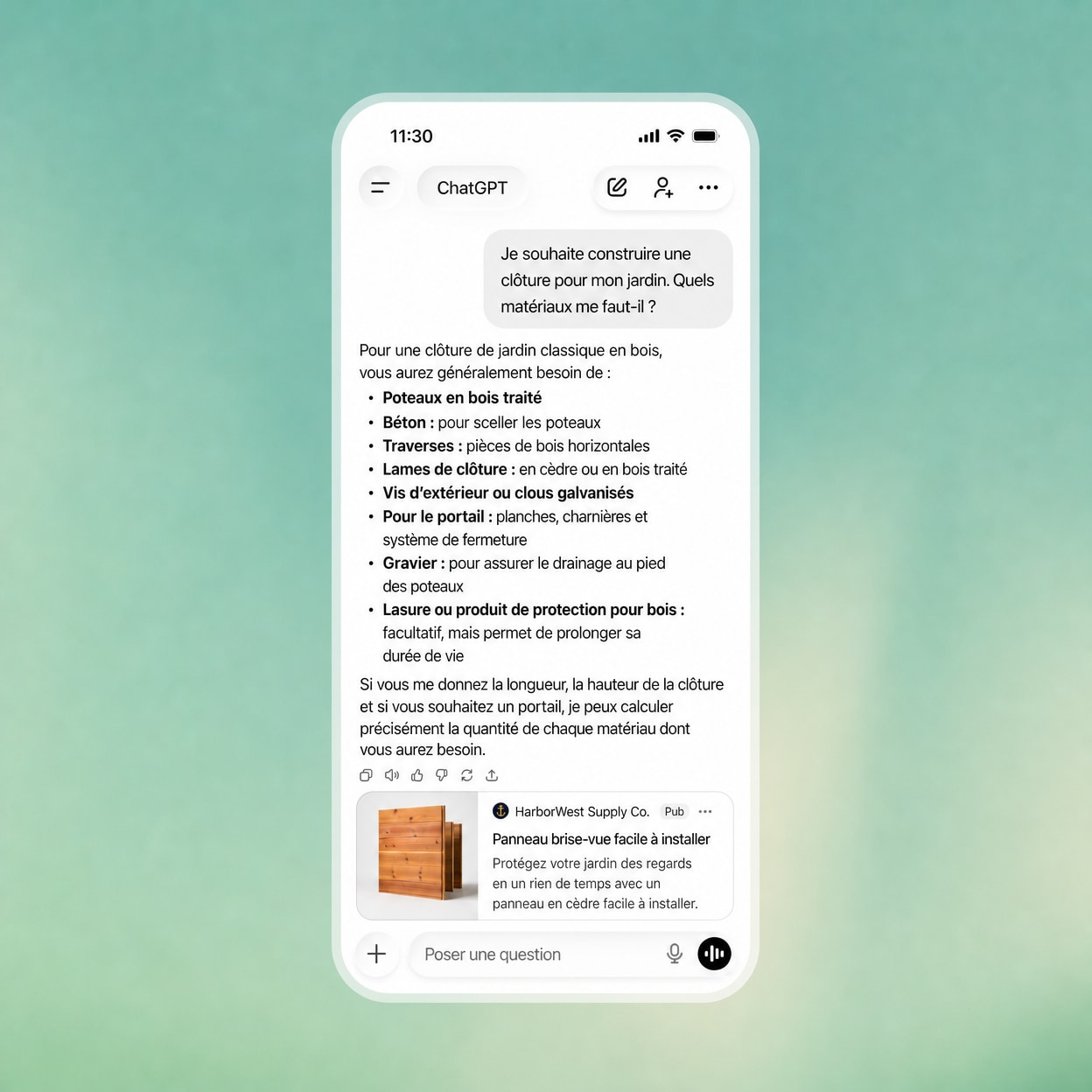
Ads appear below ChatGPT’s responses. Each ad includes:
- Advertiser’s name
- Favicon (advertiser’s logo)
- Title (headline)
- Text (description)
- Landing page
- Image asset (ad creative)
When a user interacts with the AI, the platform analyzes the overall context of the discussion, the tone of the query, the previous steps in the conversation, and the user’s underlying need. This immersive approach makes it possible, in theory, to present a product or service at the exact moment the user expresses an intention to purchase or is seeking a complex solution.
Unlike Google Ads or Bing Ads, which rely primarily on keyword auctions and search queries, the advertising model developed by OpenAI relies entirely on this predictive model. This has both advantages and disadvantages. We’ll come back to this.
Targeting
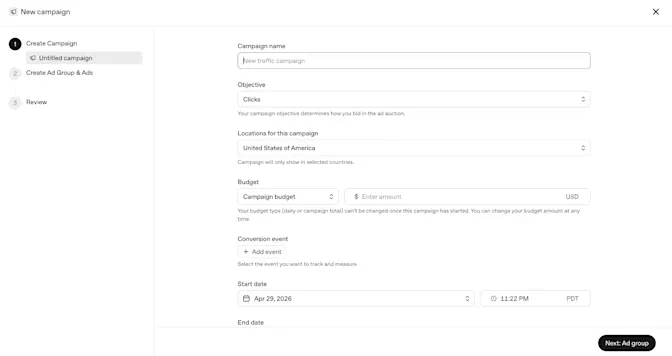
Advertisers can provide contextual cues, such as topics, conversation types, or relevant products and services. These cues help guide the matching process, but they are not exact-match keywords and do not guarantee placement in specific conversations.
Bidding and Advertising Goals
Ad space allocation is based on various models. You can ask OpenAI Ads to use CPM (cost per thousand) or CPC (cost per click).
It’s also crucial to note that advertising on ChatGPT is limited to free accounts. This is a more significant factor than one might think. The problem is that… AI power users pay for their accounts. In other words, a significant segment of people who have changed their purchasing habits cannot be targeted by ChatGPT.
A Young Advertising Channel
Despite its undeniable potential, advertising on ChatGPT should be approached with caution and deliberation. Currently, OpenAI’s advertising solution has significant limitations that should not be ignored before allocating a significant portion of your marketing budget to it.
Limited Data Maturity
Unlike established advertising platforms, the tools for reporting and tracking conversions are still in their infancy. It is difficult for an agency to measure a user’s complete attribution journey with surgical precision.
Performance and Return on Ad Spend (ROAS)
Search Engine Journal recently reported that ChatGPT has an average CTR of 1% globally. However, this is not the case in the English-speaking world. AI ads have achieved a CTR of 0.75% in Canada. When compared to the average CTR of 6.6% for search ads on Google Ads and Microsoft Ads…
We won’t tell you to jump into ChatGPT advertising blindly.
Our initial experimental data shows that, for several types of campaigns, the immediate return on investment remains lower than that achieved through direct display on traditional search engines.
Lack of control over targeting
The lack of granular control over targeting can sometimes lead to spending on low-quality impressions if the conversation strays from the initial intent. In fact, OpenAI Ads works much the same way as PMAX campaigns on Google Ads. Since they’re based on intent and modeling, it’s easier for advertisers to cast too wide a net. This makes it an imperfect tool for many types of services outside of retail.
ChatGPT Ads for Small Businesses: A Good Idea?
For most small and medium-sized businesses, it’s difficult to recommend widespread adoption of ChatGPT Ads… for now.
Marketing budgets for small and medium-sized businesses should, above all, be directed toward proven channels that guarantee a predictable and measurable return on investment. For our clients with limited budgets, we believe that traditional approaches are still highly relevant. This includes ongoing investment in Google Ads to capture users with high purchase intent, along with a strategy focused on local SEO and technical optimization of a WordPress site to ensure organic visibility.
Furthermore, for SMEs, it’s important to recognize that SEO and GEO will remain the best way to be recommended by AI for some time to come.
However, OpenAI Ads is evolving at breakneck speed. OpenAI is continually adjusting its algorithm, refining its ad formats, and improving its targeting capabilities for advertisers. The best approach to take with your web agency is to maintain active strategic monitoring.
WebCie’s Approach
At WebCie, we take an optimistic yet realistic stance toward this new tool. We are well aware that many companies have limited marketing budgets. For these businesses, avenues with uncertain returns are not suitable.
Advertising on ChatGPT is not a channel we offer to all our clients—at least not until the data and results justify the advertising investment. We still prefer to focus primarily on our Google Ads campaigns, optimized to capture users with high purchase intent, and Meta Ads to generate brand visibility.
Nor should we deny the major shift that generative AI has brought about in how customers consume information. A large segment of the population now conducts research and makes decisions with the help of a large language model (LLM). Channels like OpenAI Ads could potentially help you gain visibility and influence your customers’ purchasing decisions.
The arrival of advertising on ChatGPT signals a shift in how consumers search for information and make decisions. Businesses must therefore rethink how they build visibility. OpenAI’s solution, once it matures further, will undoubtedly be essential.
Do you have questions about your online ads? Contact us to discuss a strategy tailored to your business and budget.