

Organic Traffic Collapse on Your Website: The “Great Decoupling” of Clicks and Impressions
For the past year, you’ve been experiencing a collapse of organic traffic to your website. We know because it’s generalized. “Why is traffic to my site falling?” you wonder, scratching your head. You’ve checked your Google Analytics and Google Search Console reports recently and noticed a steady decline in your organic visits.
You’re not alone.
For over two years now, the world of digital marketing has been undergoing a major upheaval that is completely redefining how internet users interact with search engines. Your content is still of excellent quality and your rankings seem stable, and yet, the little arrow under the KPI is red and pointing downward.
Why is your website traffic dropping? Like so many things in 2025–2026, it’s linked to the rise of generative artificial intelligence. More specifically, we’re talking about the emergence of so-called “zero-click” searches (zero-click searches).
The “Great Decoupling” of Clicks and Impressions
Since last summer, major SEO sites such as Search Engine Roundtable and BDM, have observed that the number of impressions no longer correlates with the number of clicks. We’re typically shown this image:
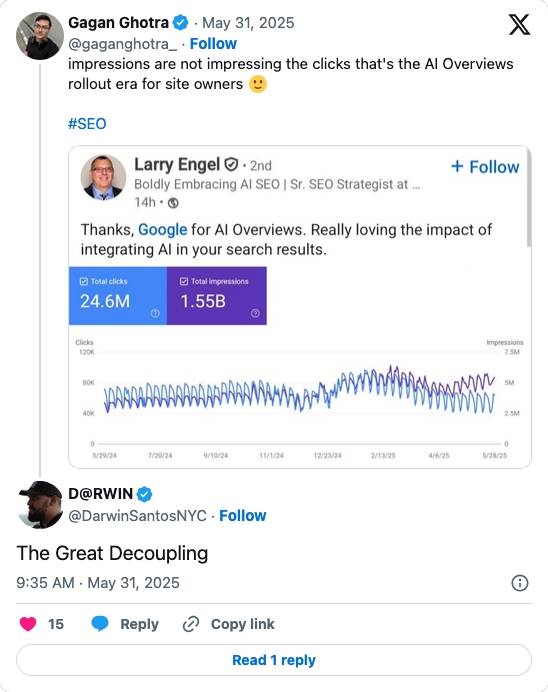
As a result, AI-powered search suggestions—such as Google’s Gemini—are being blamed for reducing organic traffic to websites.
For more than two decades, the web’s model was based on a simple agreement: the user asked a question on Google, the search engine presented a list of blue links, and the user clicked on a web page to find the information they were looking for. This traditional process has been profoundly disrupted.
With the widespread integration of generative AI directly into search engines—such as Gemini or ChatGPT—Google is no longer content to be merely a directory of links. It has become an answer engine. Put simply: Google scans your website and presents the information it finds there without even giving you a click in return.
For the past year now, when a user enters a query, the AI synthesizes information from multiple sources and displays a complete, structured, and clear answer right at the top of the search results page. The user gets what they’re looking for in a matter of seconds, without ever having to click on a link.
Organic Traffic Collapse To Your Website is Potentially Caused by AI Overviews from Gemini
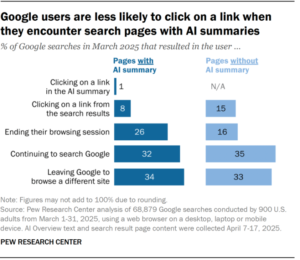
The Pew Research Center also published the results of its research on AI Overviews last July. The mere presence of Gemini’s AI Overviews would cut the number of clicks—which previously went to blue links—in half. Furthermore, the potential clicks captured by Gemini do not subsequently result in clicks via AI Overview. In fact, the presence of the AI Overview is said to cause a 10% increase in immediate session terminations.
Organic Traffic Collapse Is Disrupting Digital Marketing
This paradigm shift is hitting traditional content strategies hard. Not so long ago, publishing blog posts that answered simple questions (definitions, short tutorials, quick FAQs) guaranteed a steady stream of traffic.
Today, this so-called “informational” traffic is rapidly dwindling.
AI instantly answers these basic queries for you. Unqualified traffic—which is still very relevant for boosting your company’s brand awareness—no longer needs to visit your website to get answers. Your site appears in search results, but users no longer click on it. Impressions remain high, but clicks are dropping.
The “Great Decoupling”… Really?
At least that’s the theory that’s been circulating since last summer. Is it true?
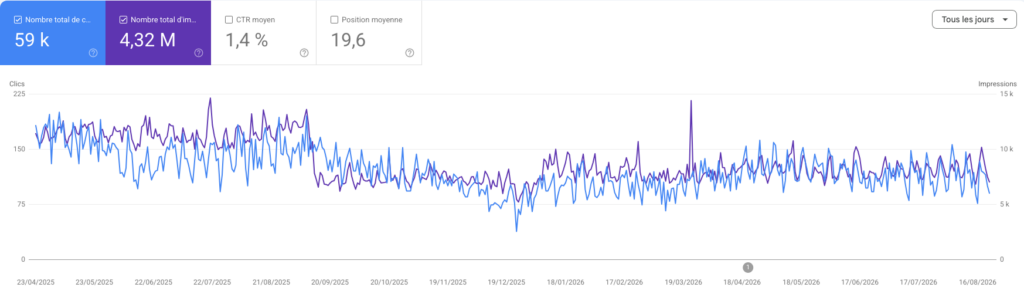
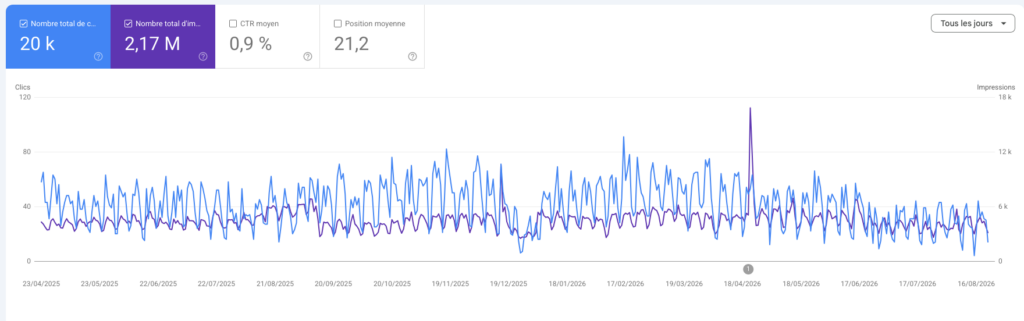
We conducted our own small investigation. When we look at our own data—from small and medium-sized businesses in Quebec—this “great decoupling” of links and impressions doesn’t appear.
In fact, here is the data from the last 16 months for three of our SEO clients.
Google Search Console Data – Client 1
Last 16 months, as of August 24, 2026
Google Search Console Data – Client 2 – August 24, 2026
Last 16 months, as of August 24, 2026
Google Search Console Data – Client 3 – August 24, 2026
Last 16 months, as of August 24, 2026
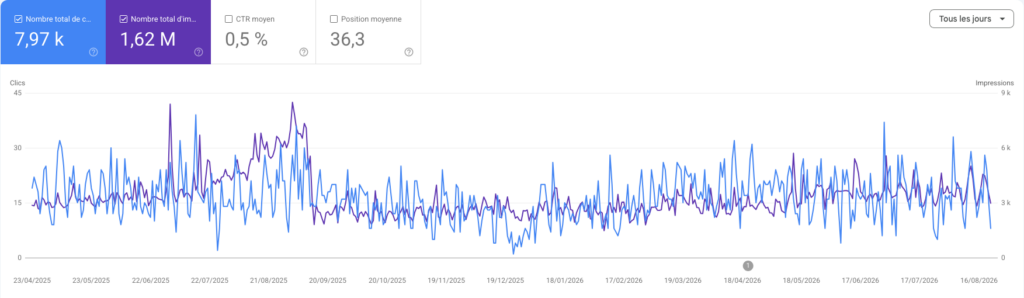
Our data does not point to a major decoupling.
However, unlike SEO gurus, who manage websites with international reach and audiences in the millions, we optimize websites that target very specific and linguistically isolated audiences. Our clients primarily target the Quebec market, specifically the Greater Montreal area. This might explain why the “great decoupling” is much less pronounced for us.
The clicks our clients receive are already high-intent, and are therefore less susceptible to the ravages of Gemini’s broad-match targeting.
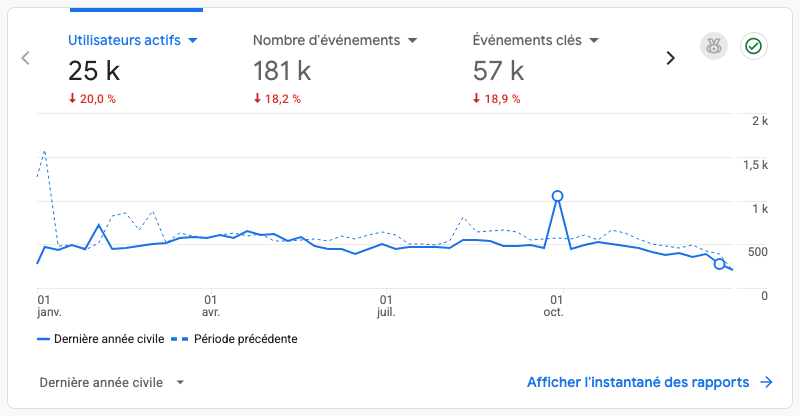
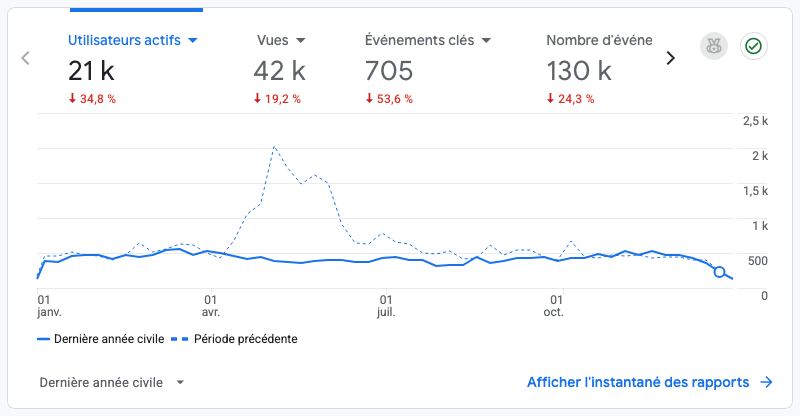
However, the reality is that Google’s changes in March 2025 did have a negative impact on traffic. Here are the same sites on Google Analytics.
Total web traffic on Google Analytics – Client 1 – August 24, 2026
2025
2026 (through August 24, 2026)
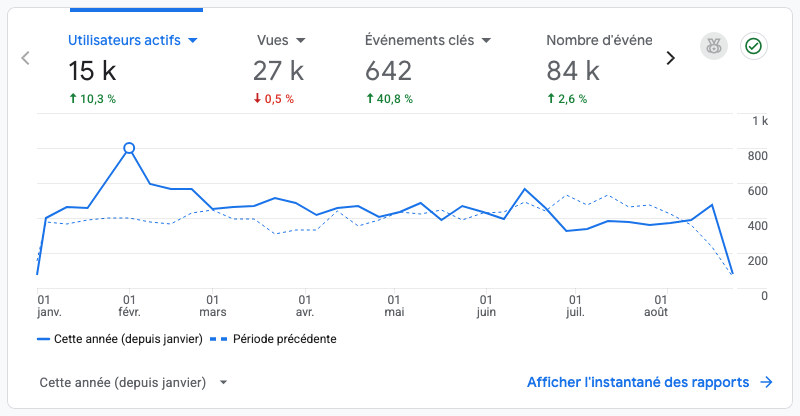
Total web traffic on Google Analytics – Client 2 – August 24, 2026
2025
2026 (through August 24, 2026)
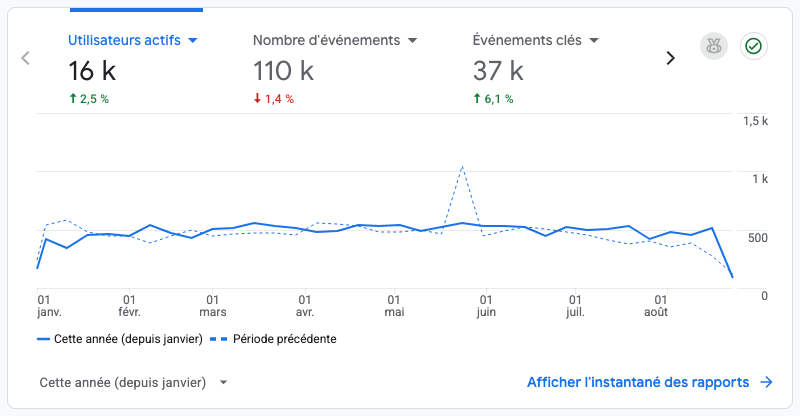
Total web traffic on Google Analytics – Client 3 – August 24, 2026
2025
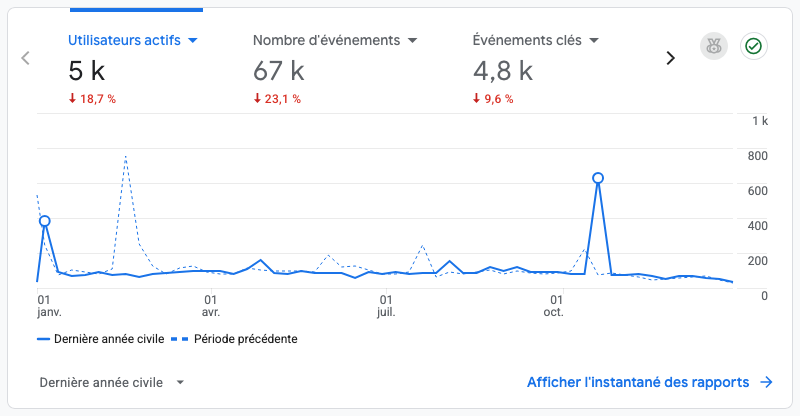
2026 (through August 24, 2026)
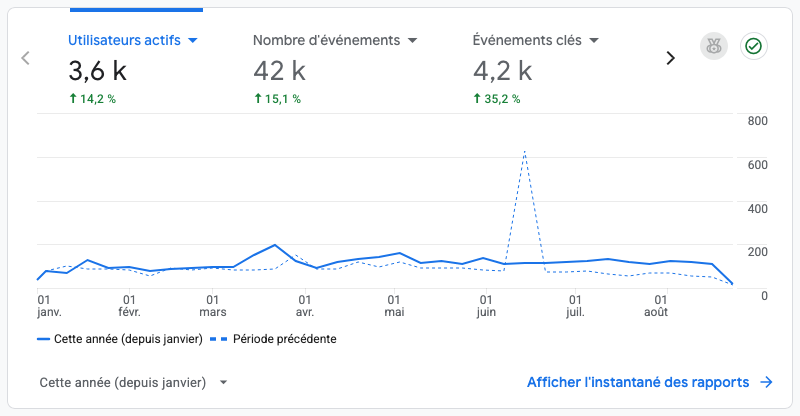
For all our clients, website traffic did indeed drop in 2025, a direct result of Google’s changes in March 2025.
However, traffic has since resumed its usual growth pattern. Google’s changes did not cause a continuous decline in traffic, but rather a rapid drop that has since stabilized. The question that remains is whether it’s possible to climb back up to the previous peak?
So, is SEO Dead?
No, not at all. However, assuming the current AI craze continues, there will be long-term changes we’ll need to make to our approach. In our article on GEO, we touched on these realities, but, in practical terms, here are the key takeaways to keep in mind moving forward.
Prioritize purchase intent. Overall traffic is declining and will remain lower than the historic peak seen around the turn of the 2020s. Increasingly, only the most qualified users will be willing to visit your website.
Quantity gives way to depth. You must go beyond sharing platitudes and generalities. People looking for a simple answer will find it in the summary.
Superficial content created solely to attract easy clicks no longer provides value in the eyes of search engines. With AI, anyone can write 600-word SEO articles. However, users who genuinely need help or are seriously considering a purchase won’t be convinced by these superficial articles.
The Rise of GEO (Generative Engine Optimization): The goal is no longer just to rank first, but to become the preferred source of information that AI cites in its summaries.
Organic Traffic Collapse To Your Website is Reversible
In other words: the more things change in SEO, the more they stay the same.
Faced with this new reality, the solution isn’t to abandon SEO, but to shift your approach toward high-value-added content that AI cannot easily replicate. Concrete case studies, expert analyses, insights based on real-world experience, and content focused on direct conversion.
Why is organic traffic to my website site dropping? At WebCie, we answer that question. We help small and medium-sized businesses navigate these major shifts in web marketing. Our SEO services in Montreal combine next-generation SEO optimization, GEO-targeted strategies, and rigorous management of your performance campaigns. Our team ensures that your business maintains its visibility and continues to generate concrete business opportunities.