


What is GEO?
Since the appearance of ChatGPT and generative AIs, traffic on websites has generally collapsed on most sites. The cause? More and more users are asking their everyday questions to their AI of choice, whether it is Perplexity, Gemini, Grok, Copilot, or, of course, ChatGPT.
Rather than going on Google, typing their question and navigating to your website, people ask their question directly to the AI, get their answer, and stop their search process. Since 2025, AIs have directly cited websites and generated hyperlinks. Search engines, notably Google and DuckDuckGo, integrate an AI summary at the top of the page to answer certain questions.
One thing is certain: users are not ready to return to their old habits.
At the same time, marketing firms and SEO agencies have started to study how to take advantage of these changes in tools and practices. We see the term GEO, short for “Generative Engine Optimization,” appearing more and more often on the websites of digital marketing and SEO agencies. This is also the case for our own website!
In this article, we explore GEO in order to discover to what extent you should include it in your marketing strategy.
What is the difference between GEO and SEO?
GEO and SEO are, in practice, very similar. An SEO agency like ours conceptualizes a website in such a way as to allow Google’s “spiders” to navigate and understand it. Natural referencing includes the use of metadata (to indicate to a computer “this is a title,” for example), technical optimization (loading speed, internal structure of the website), keyword integration (the words that users use to find your product) and the creation of quality content that users will consult and use.
SEO is the art and science of ensuring that, when a potential customer performs a search, you have a relevant web page to display among the first choices.
GEO is, fundamentally, similar. A user asks a question to their AI of choice. The AI browses the net in order to generate an appropriate answer. If the user is looking for a nearby hair salon, the AI uses the data collected on a search browser (Gemini uses, of course, Google, and ChatGPT uses Bing) and generates a summary, typically with integrated hyperlinks.
In “traditional” natural referencing, users have learned to search directly for keywords and each page is optimized for a main keyword. A user on Google.com will typically write “hair salon near” in their search bar in order to find a nearby hair salon. Google uses the IP address and cookies to respond effectively to users.
In the case of an AI, the user will ask the question in a much more natural way and in a conversational context. “Hair salon near” becomes “which hair salon would you recommend in the Ahuntsic neighborhood?” The generative engine will then browse the Internet in order to obtain an adequate answer.
The “Query Fan Out”
In a blog post published by Google with the launch of their AI Mode, Google described the method of Google AI Mode and Gemini for responding to users’ web searches. In fact, when a user asks a question to a conversational agent like Gemini, the AI secretly generates a handful of similar search questions related to the original search question.
The AI then “crawls” the first results of Google or Bing for each of these searches. The data collected during this process are used to generate an answer to the user’s question.
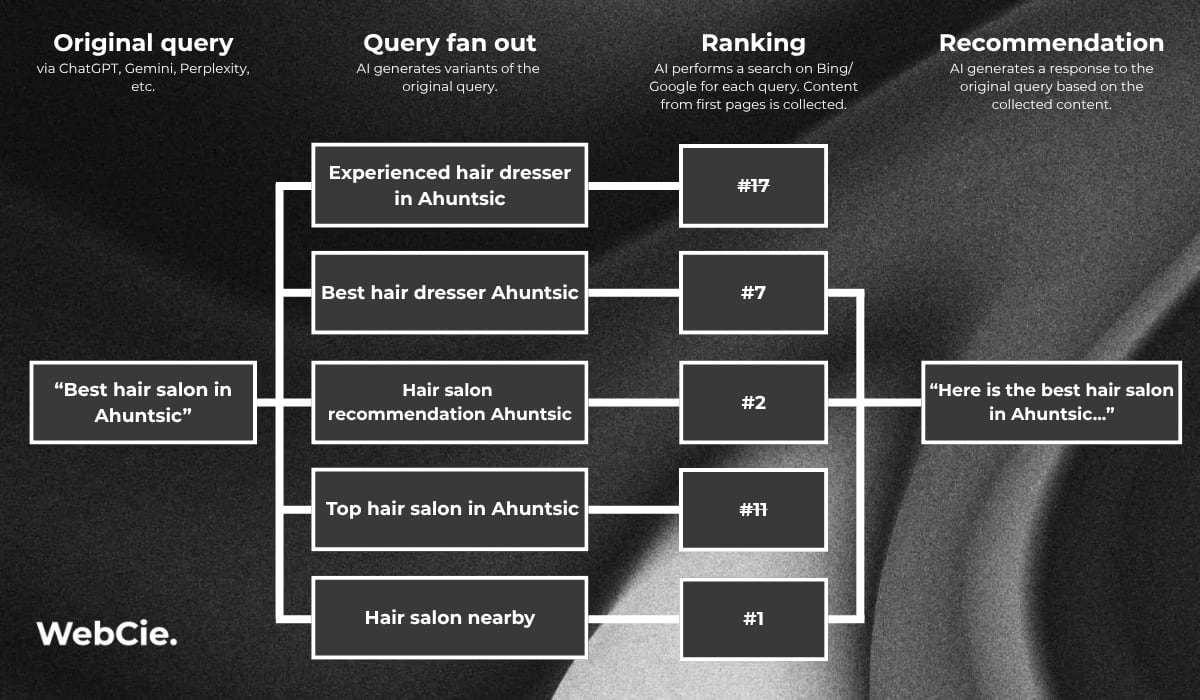
Unlike a search via keywords, it is not only a matter of a single “main keyword.” It is rather the consistency of the performance around the same theme that is rewarded. The websites and web pages that appear most frequently are those typically cited in AI-generated answers.
This explains why the results of a Google search are often different from the results of a search via ChatGPT or Gemini. The search engine brings you the results of the precise keywords that you have searched for. The AIs generate their results based on a handful of different searches inspired by your original question.
This synthesis process happens every time, but does not always cause a query fan out. In Google AI Mode and Gemini, questions like “what is the best hair salon in my neighbourhood” lead to a visible query fan out. However, a simple query like “hair salon Ahuntsic” in Gemini or ChatGPT does not necessarily provoke a full query fan out. The AI model will still generate an answer based on around ten web pages, which are typically the same ones that appear in Google.
Will AI search replace search engine search?
No. At least, not right away.
We obviously cannot see the future, but we do know that AI is a technology that is here to stay. However, it will not completely replace the use of search engines, even with the arrival of Atlas, OpenAI’s browser.
David Quaid, researcher and consultant in the matter of LLM and SEO, explains it very well: “the strength of AI is its linguistic fluidity, not its precision.” [our translation]. The Large Language Models are algorithms that arrange words in the most coherent way possible. This process does not consider whether the source is trustworthy or obsolete or whether the completed sentence is true.
AI is a content and text generation tool, whereas search engines are archiving tools. Because of these different purposes, search engines, and consequently, SEO, are not about to disappear.
Does AI search generate good results?
One of the most important changes that Google has made in recent years is the prioritization of E-E-A-T, Expertise, Experience, Authoritativeness, Trustworthiness. Google does not only read the content of the website to offer you results, but also checks its popularity, its authority, and the trust that users have toward the content. This is verified notably via inbound links. This allows, at least partially, to filter dangerous, automated, or obscure websites. When you perform a search on Google, Google not only presents you the web pages that contain your keywords, but also verifies that these websites are popular, frequently visited, and often used as sources by other human beings.
LLMs, in their very structure, do not currently have such safeguards. LLMs consider all content in their database as a statistic that is just as valid, and a model does not have the capacity to evaluate the truth or relevance of the content that it generates. Since ChatGPT, Gemini and Perplexity generate their answers using search engines, the data is indirectly filtered, however.
Until these limitations of LLMs are corrected, a gap will exist between search engines and searches via AI. LLMs are excellent at synthesizing information, but they do not have the transparency, reliability and speed of search engines. For several types of content and in several fields where reliability and proven facts are crucial, “traditional” searches will remain essential. Certain users will choose to continue using Google, and read information directly, regardless of the popularity of AI.
However, AI is already carving out a sizable place in the purchasing journey of several consumers. Some users prefer to have a conversation with “someone” before making a decision, for example. AI enthusiasts have already learned how to communicate effectively with LLM conversational agents to generate more relevant results. A significant portion of the market has already adopted AI, and it has become crucial to consider this practice in your web presence.
The practices that our SEO specialists have adopted for GEO in 2025
At WebCie, we see GEO as a new crucial facet of our SEO agency services. Even if ChatGPT, Perplexity and Gemini will not completely replace search engines, they already represent an important share of web traffic.
The difference lies mainly in the way your content must be optimized. In “traditional” SEO, each web page typically has a main keyword. With query fan out, each main web page must be optimized to perform with a variety of different wordings of the main subject of the page.
Subpages (often blog articles) have gained in importance in order to maximize the performance of the overall domain. In a world where keywords are more frequently reworded by AI, you will need to go beyond simply optimizing for your “money keyword”.
For some time now, we have also integrated into our website audit process a series of tests via ChatGPT, Gemini and Perplexity. We do this to identify how popular AIs rank our clients and possible avenues to improve. This allows us to build better SEO plan that optimize for Generative Engines.
If you have any question about the impact of GEO on your web performance, contact us right now.